Have you ever thought, “there are not enough hours in the day?” With all the things you need to do, like finish your assignments, go to your meetings, run your routine tasks, do your housework, etc. sometimes you don’t even come close to finishing your to-do list. Often, this is due to poor time management skills.
Everyone has time management skills, but improving those skills can improve your quality of life. Students, professionals, and business owners all have to manage their time, as well as homemakers. Time management is essential for everyone, and everyone can benefit from simplifying their life with the right time management skills.
The right skills can allow you to use your time more productively, and better manage your stress.
In this blog, we will look at different ways to manage time, as well as ways you can use these ideas in your daily life.
What Are Time Management Techniques?
Time management is the ability to plan and schedule your day by making decisions on what work needs to be done first, how long to work on a task and when to take a break.
As an example, let’s assume you have 5 things to do today. Rather than doing them in a haphazard manner, you can prioritize them and do the most important ones first.
This is a very simple example of time management.
Using the proper time management techniques can allow you to:
- Get your tasks done in a timely manner.
- Not waste time doing irrelevant activities.
- Be conscious of the activities that help you work towards your goals.
- Avoid procrastinating, and feeling stressed out because of last minute work.
- Create a balance of work and leisure activities.
- Achieve higher task productivity without feeling exhausted.
Now, we will learn about some of the popular time management techniques.
10 Popular Time Management Techniques You Should Know
There are hundreds of different time management techniques that are available to the public, but the key is to find the techniques that work best for you. Some people may prefer one technique over the other for various reasons, and this may be the case for you.
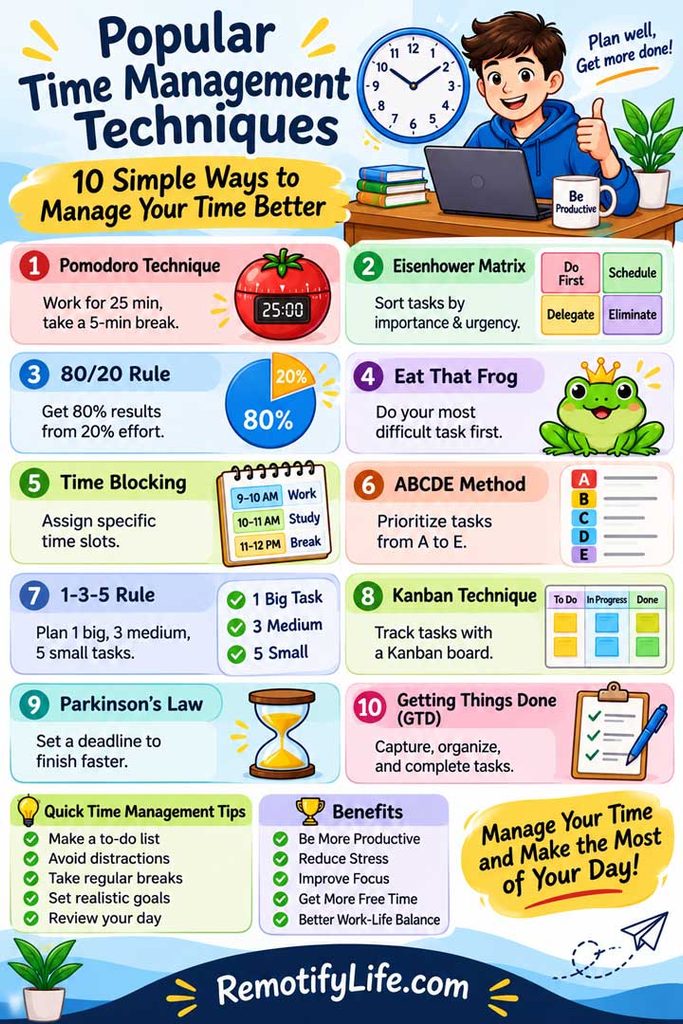
Here are ten different time management techniques that can potentially help you improve your time management skills.
1. The Pomodoro Technique
The Pomodoro Technique is one of the more popular time management techniques. It is especially helpful if you have focus and concentration issues for long durations.
It was invented by Francesco Cirillo. He studied using a tomato-shaped kitchen timer and therefore named the method after the Italian word for tomato: Pomodoro.
The technique consists of working for short durations and taking breaks in between. Each work duration is called a Pomodoro and is typically 25 minutes long. After you have completed a Pomodoro you take a 5 minute break. After every 4th Pomodoro, you take a longer break which is typically 20-30 minutes long.
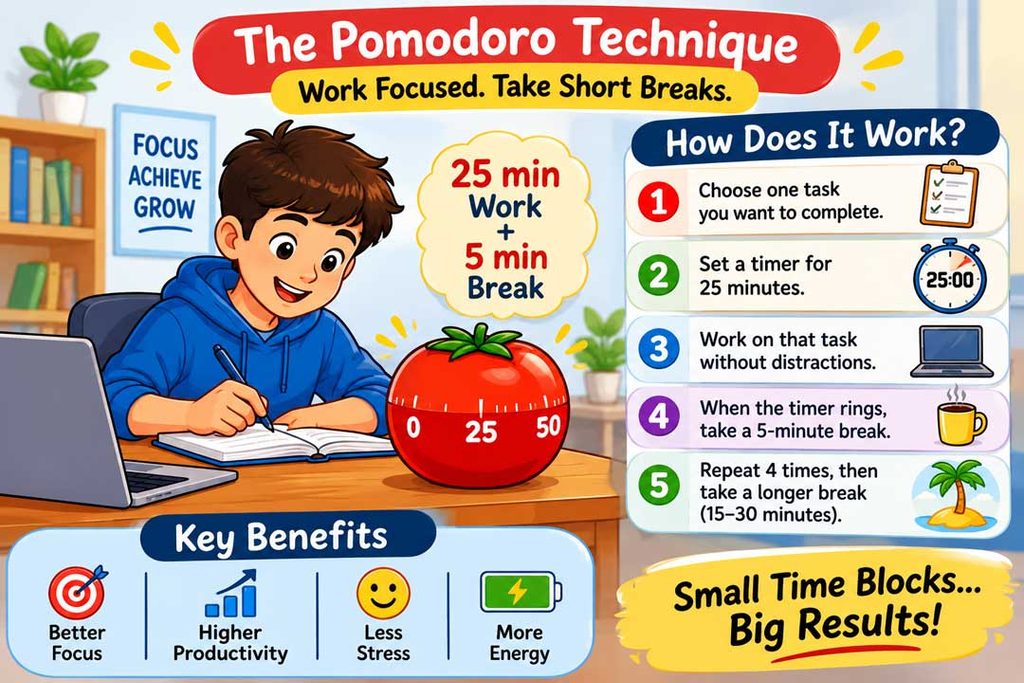
How does it work?
- Decide on a task you would like to accomplish.
- Set a timer for 25 minutes.
- Work on the task for 25 minutes, do not work on anything else.
- When the timer goes off, take a 5 minute break.
- Repeat 4 times.
- When you have finished 4 sessions, take a break for 15-30 minutes.
Example: If you have to write a blog post, you might try to write the whole thing at once. Instead, you can try writing for 25 minutes, taking a 5-minute break, and then repeating.
It might help to set a timer for each writing session and break.
This way you can stay focused and not get really tired from writing for a long time.
2. The Eisenhower Matrix
How do you decide which of the many tasks you have to do, you should do first?
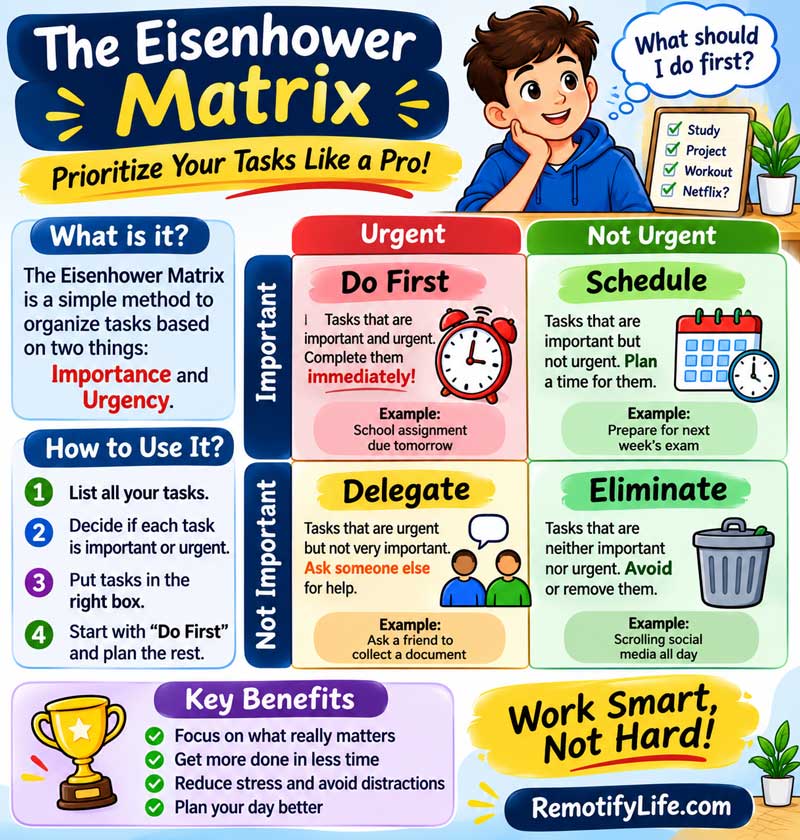
The Eisenhower matrix can assist you with this. It involves grouping tasks according to their level of importance and urgency.
You then group tasks into four categories.
The four categories are:
- Do First: These tasks are both important and urgent. You should complete them immediately.
- Schedule: These tasks are important but not urgent. Plan a proper time to complete them.
- Delegate: These tasks are urgent but not very important. If possible, ask someone else to help.
- Eliminate: These tasks are neither important nor urgent. Avoid spending too much time on them.
Example: You have an assignment due tomorrow, a project due next week, and a video you want to watch.
Your assignment comes before the project and the video, since your assignment is both urgent and important, the project can be scheduled for later, and watching videos can be done in your free time.
This method can be used to decide which tasks to do next.
3. The 80/20 Rule (Pareto Principle)
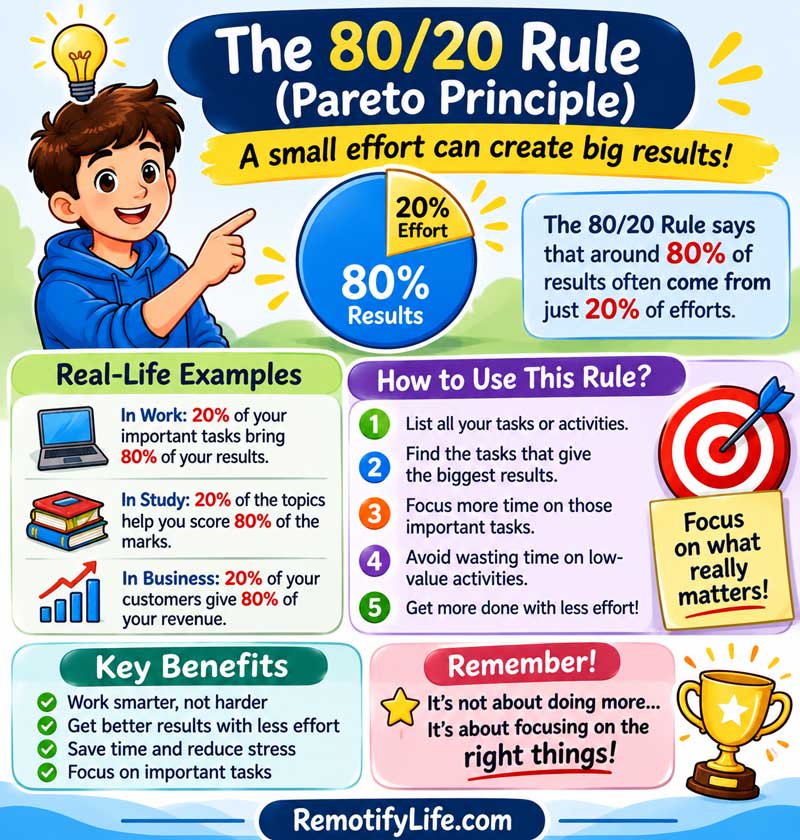
The 80/20 Rule (also called the Pareto Principle) states that around 80 percent of results come from about 20 percent of causes.
This means that a small number of important activities produce most of the results.
An illustration of this would be if you have a to-do list for the day that consists of 10 tasks. There are usually a few tasks on that list that are more critical than the others and contribute more to the goal you are trying to achieve. You should always spend the most time on the important tasks to get the best results.
One way to practice this would be to
- Write down all of the tasks that you need to accomplish.
- Identify the important tasks on that list.
- Focus on the tasks that will produce the biggest results.
The important part is to spend the least amount of time on tasks that will give you the smallest results, and focus the most time on the biggest results.
The 80/20 Rule is not to be taken exactly, but rather used as a general principle.
This is a good technique for someone that has a hard time focusing on the important tasks, instead of just doing lots of little things throughout the day.
4. Eat That Frog Technique
The name of the technique is intended to be humorous, but there’s a good reason for it.
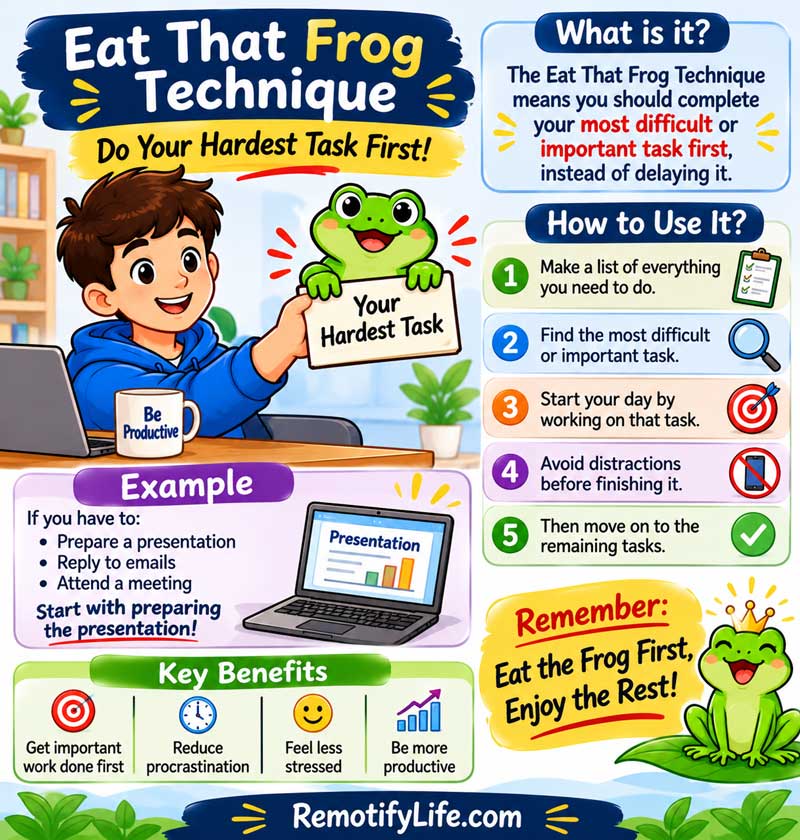
The Eat That Frog technique is based on the idea of doing your most important or difficult task of the day first. This idea has been popularized by Brian Tracy.
There’s this one difficult task that you dread doing, and you might find yourself thinking about it the rest of the day. This builds stress.
Rid yourself of this stress, and do the task first thing. Then the rest of the tasks for the day feel easier.
How do you do this?
- Make a list of all the things you need to do for the day.
- From that list, find the most important or difficult task.
- Doing this task first, before doing anything else should be your focus for the day.
- Don’t check your social media or do other random things before doing this task.
- Now do the other tasks for the day.
Example: If you have to do an email, prepare a presentation, and do a meeting; you can prepare the presentation first if that’s the most important/difficult task of the day.
This technique is great for the habit of procrastination.
5. Time Blocking Technique
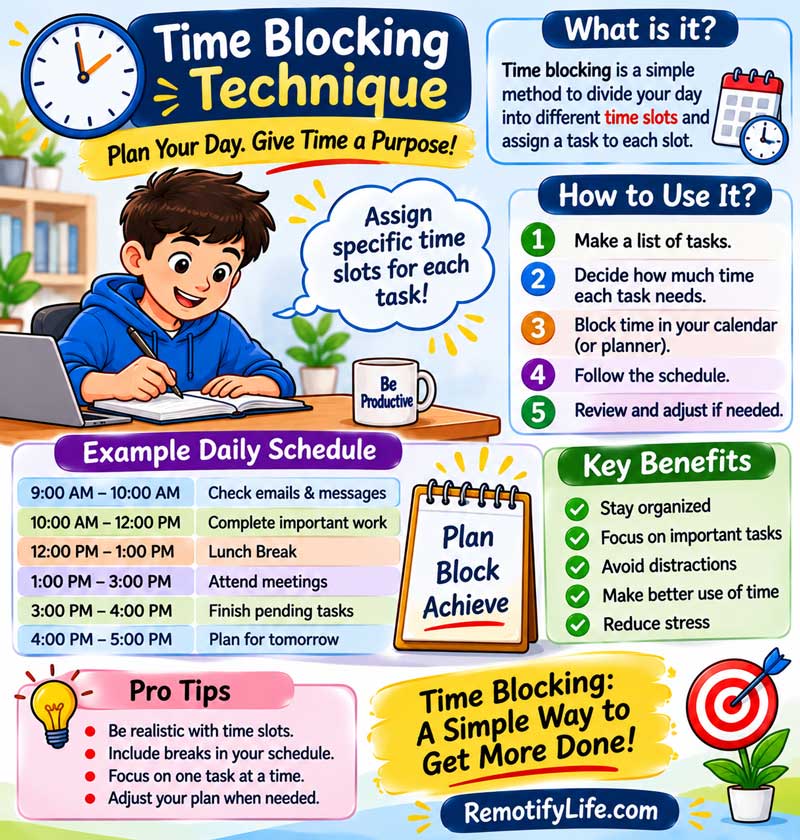
Time blocking is organizing your day into intervals of time, and then assigning a task to each block. This makes your day’s plan in advance, thereby eliminating the need to decide what to do next every few minutes.
For example, you would need to prepare a schedule like this:
- 9:00 AM – 10:00 AM: Check emails and messages.
- 10:00 AM – 12:00 PM: Work on important tasks.
- 12:00 PM – 1:00 PM: Break
- 1:00 PM – 3:00 PM: Attend meetings
- 3:00 PM – 4:00 PM: Work on tasks
- 4:00 PM – 5:00 PM: Review work
The schedule can be adjusted based on your convenience.
Time blocking offers a few benefits. The major one is organization. Every task for the day is allotted a time. You’re also less likely to get stuck on a single task for a long time.
6. The ABCDE Method
The ABCDE Method is a priority-based time management technique.
In this method, you sort your tasks according to their priorities by assigning them letters from A to E.
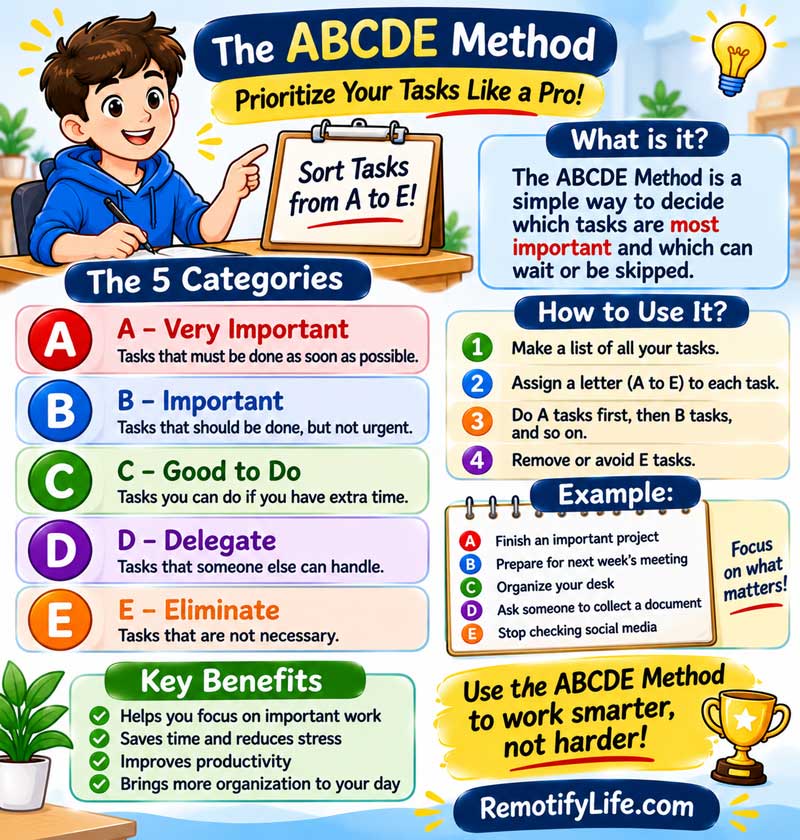
Here’s what the letters signify:
- A tasks are Very Important. These are tasks that need to be completed as soon as possible.
- B tasks are Important. These are tasks that need to be completed, but not as quickly as A tasks.
- C tasks are Good to Do. These are tasks that are to be completed if time permits.
- D tasks are Delegate. These are tasks that can be accomplished by someone else.
- E tasks are Eliminate. These are tasks that are unnecessary, and can be completely disregarded.
For example, let’s say you’ve collected the following tasks:
- A – Complete an important assignment.
- B – Prepare for next week’s meeting.
- C – Organize your desk.
- D – Ask someone to pick up a document.
- E – Disregard distractions and stop checking notifications.
Using this method, you have the ability to prioritize and complete the most important tasks first.
This is particularly helpful when you have so much to do that you don’t know where to begin.
7. The 1-3-5 Rule
The 1-3-5 Rule is a simple method to create a daily to-do list that isn’t overwhelming. You breakdown your to-do’s into 3 categories.
- Big tasks
- Medium tasks
- Small tasks
Adding up the numbers gives you a total number of tasks you want to accomplish in a day (9). However, this is broken down into smaller more manageable categories.
You might have a to-do list like this:
One Big task
- Complete important project
3 Medium tasks
- Respond to important emails
- Attend team meeting
- Prepare report
5 Small tasks
- Organize desk
- Check calendar
- Make shopping list
- Respond to message
- Plan tomorrow’s activities
This method is great because it stops you from overloading yourself with the biggest tasks of the day. You have a clear idea of your big tasks for the day at the beginning of the day.
8. The Kanban Technique
The Kanban Technique is a visual technique to manage the activities you perform. It helps you understand what work needs to be done, what work you are performing now, and what work you have completed.
You can create a Kanban board with the help of a notebook, a whiteboard, sticky notes, or any other digital/physical medium of your choice.
A basic Kanban board looks like this:
To Do | In Progress | Done
To use it,
- Add all your work in the To Do section.
- Once you start working on a task, move it to the In Progress section.
- After you complete a task, move it to the Done section.
Let’s say you are working on a website project and have tasks like writing content, designing pages, checking images, and testing the website.
Using this technique feels great because you get a huge boost of satisfaction when you see a huge list of tasks getting moved to the Done section.
This technique is great for managing work for teams and individuals.
9. Parkinson’s Law
The main idea of Parkinson’s Law is that work will take up the time allotted for completion.
Let’s say you’re given a small assignment that will take one hour to finish. With a whole day to finish it, you may spend the entire day on it. On the other hand, with a one-hour deadline, you may finish it in that time.
How can Parkinson’s Law be useful?
- Set deadlines for the tasks you do each day.
- Avoid wasting time making lots of small changes to a document.
- Break large tasks into small activities.
- Aim to finish an assignment before the actual due date.
- Limit distractions while working.
This technique will help you be more mindful about how you spend your time.
Just be sure that your deadlines are realistic.
10. The Getting Things Done (GTD) Method
Getting Things Done (GTD) is David Allen’s popular productivity and time management system.
This method provides a central location to capture and manage all of the little things you need to do, so you don’t have to keep it all in your head.
It is made up of 5 steps:
- Capture: Capture everything that needs to be done.
- Clarify: Be clear on what each item means and what needs to be done.
- Organize: Put things into appropriate categories.
- Reflect: Look over your list of things to do and edit/update it.
- Engage: Act on the things to do according to their priority.
Let’s say you’ve got a bill to pay, a presentation to prepare, groceries to buy, and a report to write.
Instead of remembering to do all of those things, write them down. Organize them based on when they need to be done and how important they are.
By doing this, you can be productive and focused on your work instead of wasting your time and mental energy thinking about all the things you’ve got to do.
How to Choose the Right Time Management Technique?
Now that you know about ten popular time management techniques, you might be wondering which one is best.
The answer is simple: There is no single technique that works perfectly for everyone.
Some people like following a fixed schedule, while others prefer working with flexible task lists.
Here are some suggestions:
| Your Problem | Technique to Try |
|---|---|
| You get distracted easily | Pomodoro Technique |
| You cannot decide what to do first | Eisenhower Matrix |
| You spend time on unimportant tasks | 80/20 Rule |
| You keep delaying difficult tasks | Eat That Frog |
| You do not have a proper daily schedule | Time Blocking |
| You have too many tasks | ABCDE Method |
| You struggle to plan your daily workload | 1-3-5 Rule |
| You want to track task progress | Kanban Technique |
| You take too long to finish simple tasks | Parkinson’s Law |
| You forget important tasks | Getting Things Done |
You can use several techniques at the same time. You can use the Eisenhower Matrix to prioritize things to do. And then you can use the Pomodoro Technique to get your work done.
The important thing is to see which methods provide the greatest value in terms of simplifying your day.
Simple Time Management Tips to Follow Every Day
Apart from using the previously mentioned methods, there are some habits that can help you better manage your time.
1 To Do Lists
To help you remember what you need to do, make a list before you begin your day.
2 Avoiding Multitasking
You will be able to focus better on a particular task and thus be more productive if you do not do too many things at the same time.
3 Ignore Distractions
You lose a lot of time with unnecessary mobile notifications, social media, and other online browsing. Avoid using your mobile when you are working on an important task.
4 Take Breaks
Don’t work continuously. Your mind needs some breaks in order to recharge.
5 Be Realistic
Don’t set yourself goals that are too challenging and unrealistic. Setting too many challenging goals can make you feel overwhelmed and drained.
6 Say No
If you have important work to do and some other person asks you to do something, it is alright to say no.
7 Review Your Day
Every day review what you have accomplished, and what is still to be done. This will help you to plan your to do list for the next day.
Benefits of Using Time Management Techniques
Using time management techniques is not just about completing more tasks. It is also about making your daily life more organized and comfortable.
Here are some important benefits:
- Better Productivity: You can complete more important tasks by using your time wisely.
- Less Stress: Planning your activities helps you avoid last-minute pressure.
- Improved Focus: You know what you need to work on, which makes it easier to concentrate.
- Better Decision-Making: You can decide which activities need your attention first.
- More Free Time: When you finish your work on time, you get more time for family, friends, hobbies, and relaxation.
- Improved Work-Life Balance: You can give proper attention to both your professional and personal responsibilities.
Remember, good time management does not mean working all the time. It means using your available time in a smart way.
There are many benefits to managing your time well. Here are the main ones.
- Productivity: Time management helps you to utilize your time in a manner that allows you to achieve more important things.
- Less Stress: It eliminates last-minute pressure because you are able to plan your activities.
- Improves Focus: Since you know what you need to do, you are able to concentrate on it.
- Improves Decision Making: You are able to determine which activities to do first.
- More Free Time: When you are able to complete your duties on time, you are able to create time for yourself and for other people and activities you love.
- Better Work-Life Balance: You are able to give adequate time to your jobs and yourself.
Time management does not mean you work all the time. It means you use your available time in the right way.
Frequently Asked Questions (FAQs)
1. What are the most popular time management techniques?
Some of the most popular time management techniques include the Pomodoro Technique, Eisenhower Matrix, 80/20 Rule, Eat That Frog, Time Blocking, ABCDE Method, 1-3-5 Rule, Kanban Technique, Parkinson’s Law, and Getting Things Done (GTD).
2. Which time management technique is best for beginners?
The Pomodoro Technique and Time Blocking are good starting points for beginners. Both methods are easy to understand and can help you build better daily habits.
3. How can I improve my time management skills?
You can improve your time management skills by preparing a daily to-do list, setting clear goals, avoiding distractions, prioritizing important tasks, taking regular breaks, and reviewing your progress.
4. Why is time management important?
Time management is important because it helps you complete tasks on time, reduce stress, improve productivity, and maintain a better balance between work and personal life.
5. Can I use more than one time management technique?
Yes! You can combine different techniques depending on your needs. For example, you can use Time Blocking to plan your day and the Pomodoro Technique to stay focused while completing tasks.
6. How can time management help reduce stress?
When you plan your tasks and know what needs to be completed, you do not have to worry about everything at the last minute. This helps you feel more organized and reduces unnecessary stress.
Conclusion
Proper management of time can be of immense help when you are studying, working or doing anything else that requires the management of your time. The right use of time management techniques can prove to be of great use.
It is not necessary that you should implement all the techniques mentioned in this blog in your life. Try implementing a technique that you think you can incorporate in your daily life easily. Look for its effects on your task completion.
It is important to remember, the point of time management is not to be busy all the time. It is to manage your time in such a way that you get sufficient time for things that you enjoy, and also have time for important things.
Therefore, plan your day, set your priorities and use your time judiciously!
Time is precious, so use it wisely.