Working from home can be both comfortable and challenging. We all think that freelancing or working from home is freedom and easy. The cozy environment and loneliness can shift your focus, making it easy to drift away and resulting in less productivity. This is common for many people trying to improve their remote work productivity.
This is why improving your mindset with better energy management, distraction control, and focus enhancement helps strengthen your remote workflow and overall home office efficiency.
What productive working from home looks like today
Working from home benefits you by saving travel time and enjoying more personal freedom. The extra time saved in commuting can be used for side hustles. Planning, scheduling, and timekeeping during these additional hours increases work-from-home focus, efficiency and productivity.
Understanding this balance helps you build stronger habits for success. I will share a few productivity hacks that helped me enjoy my freelancing and increase productivity.
These small changes empowered my freelancer workflow and made my routine more effective.
Table of Contents
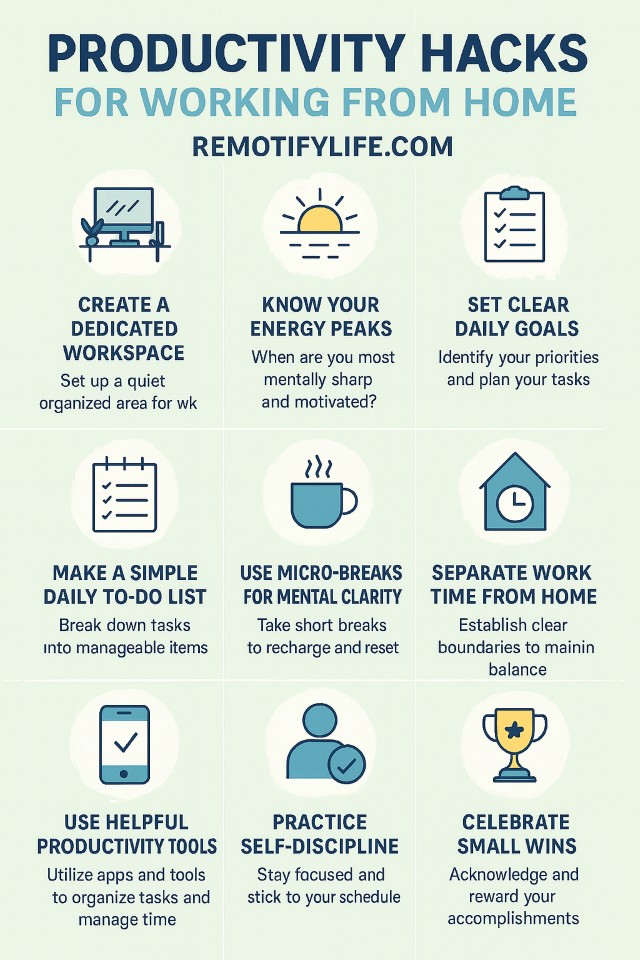
- Create a Dedicated Workspace for Better Productivity
- Know Your Energy Peaks to Improve Workflow
- Set Clear Daily Goals for Effective Remote Work
- Making a Simple Daily To-Do List for Better Focus
- Use Micro-Breaks for Mental Clarity While Working From Home
- Separate Work Time From Home Time for Better Balance
- Use Helpful Productivity Tools to Stay Organized
- Practice Self-Discipline to Stay Focused at Home
- Celebrate Small Wins to Boost Your Motivation
- Review and Improve Your Work Weekly
Create a Dedicated Workspace for Better Productivity
This is my favorite and important productivity task. Keeping a dedicated room or an area for work purposes is very important. Your workspace doesn’t need to be fancy, but it should be calm and organized. A dedicated workspace gives your mind the signal that it’s time to focus. It helps you separate your job from the rest of your home life. Creating a stable home office setup with good ergonomics, boundaries, and a structured approach boosts concentration and accountability, increasing your overall remote work productivity..
As a software developer, I always prioritize my workspace. Getting a good 4K monitor setup gives me more screen time without straining my eyes. Even a good laptop does. These are all good investments to increase productivity and support a more efficient ergonomic workspace.
A well-organized home office setup or work-from-home workspace enhances motivation and optimizes workflow.
Ergonomics that protect your back. Pick an ergonomic chair and an adjustable desk or standing desk. Small tweaks and adjustments add up and keep you comfortable during long hours of work, making your space a more distraction-free workspace.
Keep your space clean and organized. Whenever you sit in your workspace, you should feel like doing more tasks. A cluttered space creates a cluttered mind. Keep only what you need on your desk. Keep your laptop, notebook, and maybe a plant for a touch of calm. I honestly love keeping a plant that gives a very good vibe.
“Good organization habits directly support prioritization and concentration boost.”
Your environment influences your mood, focus, and motivation. When you work in a space that feels chaotic or uncomfortable, your brain struggles to concentrate. However, when your environment is calm, organized, and built with intention, your mind naturally shifts into a more productive state. That’s how you complete work like a champ. Maintaining this environment strengthens discipline and supports more effective task management.
| Main Idea | Key points |
|---|---|
| Dedicated Workspace Matters | A separate work area signals your brain that it’s time to focus and helps divide home life from work life. |
| Calm Environment | Your workspace doesn’t need to be fancy—just peaceful and distraction-free. |
| Ergonomics & Structure | Good chair, proper posture, and a stable setup improve concentration and accountability. |
| Tech Investments | A good 4K monitor or a high-quality laptop reduces eye strain and enhances efficiency, especially for developers. |
| Clean & Organized Desk | A tidy workspace motivates you to work more and prevents mental clutter. |
| Minimal Setup Essentials | Only keep the essentials: laptop, notebook, and maybe a calming plant. |
| Plants for Mood Boost | A simple plant adds positive energy and improves the vibe of the workspace. |
| Organization Supports Focus | Good organization habits help with prioritization and improve concentration. |
| Environment Shapes Productivity | A messy or chaotic space disrupts focus, while an intentional setup boosts motivation and discipline. |
| Builds Long-Term Discipline | Maintaining a clean, structured environment reinforces productivity habits over time. |
Know Your Energy Peaks to Improve Workflow
Timing is crucial. Pay attention to your energy peaks. These are specific times in the day when you feel mentally sharp, motivated, and ready to focus.
For many people, the early morning brings a sense of clarity. Tracking these moments helps balance your workflow and improve overall efficiency, especially when aiming for better energy management and work-from-home productivity.
A software developer like me feels that late-night working is more productive because the whole world is asleep, and you can work peacefully. It doesn’t mean to work late at night; it is just a time that brings more productivity.
To identify your energetic or productivity time, observe yourself for a few days. Notice when you feel lazy, or feel distracted, or even stressed. Keep a simple note of these patterns. Once you identify your high-energy periods, protect them. Schedule your hardest tasks first. Work on those tasks during those powerful times. These minor adjustments can significantly enhance your output while reducing stress and strengthening self-management and remote workflow optimization.
| Main Idea | Key points |
|---|---|
| Energy Peaks Matter | Everyone has certain times in the day when they feel most active and focused. |
| Morning Clarity | Many people think clearly and work better in the early morning hours. |
| Night Productivity (for some) | Some people, like software developers, feel more productive at night because it’s quiet and peaceful. |
| Track Your Energy | Watch yourself for a few days to see when you feel tired, distracted, or full of energy. |
| Write Down Patterns | Keep a small note of when you feel your best and when you feel low. |
| Use Your Strong Hours Wisely | Do your hardest and most important work during your high-energy times. |
| Avoid Hard Tasks During Low Energy | Save easier tasks for times when you feel lazy or stressed. |
| Protect Your Peak Times | Don’t let distractions interrupt you when your energy is high. |
| Better Output | Working during strong energy times helps you finish tasks faster and better. |
| Less Stress | Matching work with your natural energy makes your day easier and less stressful. |
Set Clear Daily Goals for Effective Remote Work
Setting clear daily goals is one of the most powerful habits you can develop when working from home. Without structure, your day can easily become a mess, resulting in a lower productivity rate and weaker remote work productivity.
I have gone through this. Even before completing the current task, I would already be thinking about the next task. This is where better planning and tasking improve workflow and create stronger daily planning habits.
You may find yourself jumping from one task to another, wasting time deciding what to do next, or feeling overwhelmed by too many responsibilities.
Clear goals help you to stay on track even on a busy day. When you know exactly what needs to be done, your mind feels more organized and calm. It also boosts focus improvement, reduces decision fatigue, and strengthens workflow clarity and prioritization.
| Main Idea | Key points |
|---|---|
| Daily Goals Are Important | Clear goals help prevent your day from becoming messy or confusing. |
| Lack of Structure Hurts Productivity | Without a plan, you may get less work done and feel stressed. |
| Personal Experience | You may start thinking about the next task before finishing the current one. |
| Planning Helps | Good planning and tasking make your workflow smoother and more organized. |
| Avoid Task Jumping | Without goals, it’s easy to jump between tasks and lose time. |
| Too Many Tasks Can Overwhelm You | A long to-do list can make you feel confused or frustrated. |
| Goals Keep You on Track | When you know what to do, you stay focused even on a busy day. |
| Creates a Calm Mind | Clear goals make your mind feel more organized and relaxed. |
| Better Focus and Priority | Goals help you focus on important tasks first. |
| Improves Overall Productivity | Setting goals makes it easier to finish tasks and stay consistent. |
Making a Simple Daily To-Do List for Better Focus
Every day, make sure you set a task list or a to-do list. Many people write long lists of tasks that they can finish in a single day. This leads to frustration and discouragement.
Keeping tasks small or micro tasks should be a good, productive working from home recipe for better workflow efficiency and clearer remote work planning.
I usually set 2 types of tasks. Higher level and micro level. A higher level is like developing a complete web page today; the micro level is developing each section of that page. This kind of task breakdown keeps my tasks organized and makes them feel smaller and more achievable.
A micro task list gives you a sense of control and increases your confidence when you complete each task. This simple method supports a stronger productivity system and helps maintain steady progress without stress.
| Main Idea | Key Points |
|---|---|
| Make a daily to-do list | Write a small list of tasks each day so you don’t feel stressed. |
| Avoid long task lists | Too many tasks in one day can make you frustrated and tired. |
| Use micro tasks | Break big tasks into small steps to stay productive at home. |
| Two types of tasks | 1) Higher-level tasks – big goals (like making a full webpage). 2) Micro tasks – small steps (like making each section). |
| Stay organized | Splitting tasks helps you see what to do next without confusion. |
| Feel more confident | Finishing small tasks gives you control and boosts your confidence. |
Use Micro-Breaks for Mental Clarity While Working From Home
Taking smart breaks is an essential part of staying productive when working from home. We believed that working nonstop could result in more work done, but that is the opposite. Your brain needs rest. Without breaks, your mind becomes foggy, your energy levels drop, and even simple tasks begin to feel much harder than they should.
Micro Breaks support energy management and strengthen discipline.
Taking breaks doesn’t waste time; in fact, they help you work faster and with better quality and efficiency. The most important thing to understand is that breaks should be intentional. If a break is when you get distracted, check your phone, or wander around the house without a plan. This type of break doesn’t refresh your mind. Instead, it pulls you away from your tasks.
A smart break, however, serves a clear purpose: to recharge your mental and physical energy, allowing you to return to work stronger. This also improves concentration and overall workflow design.
Smart breaks also support emotional well-being. Working from home can sometimes feel overwhelming or isolating. Taking a moment to breathe deeply, drink water, or simply relax helps reduce stress. These pauses give you space to reset your thoughts and return with a calmer mindset. When your emotions are balanced, your work naturally becomes more efficient
Another helpful habit is taking task-based breaks. This means giving yourself a break after finishing a meaningful task, not just based on time. Completing something gives your mind a sense of closure, making the break feel more rewarding. It also builds momentum because each completed task encourages you to move confidently to the next one.
Your brain functions in the same way. Smart breaks protect your energy, boost your creativity, and make your work-from-home routine more sustainable. A well-rested mind always performs better than a tired one.
| Main Idea | Key Points |
|---|---|
| Your brain needs breaks | Working nonstop makes your mind tired, foggy, and slow. |
| What micro-breaks do | Small breaks help you stay focused, energetic, and disciplined. |
| Breaks help productivity | Breaks don’t waste time — they actually help you work faster and better. |
| Intentional vs. random breaks | A planned break refreshes you. Random breaks (like checking your phone) distract you. |
| Purpose of smart breaks | Smart breaks recharge your body and mind so you return stronger. |
| Emotional benefits | Breaks help you calm down, reduce stress, and feel less overwhelmed. |
| Task-based breaks | Take a break after finishing a task — it feels rewarding and builds momentum. |
| Long-term benefits | Smart breaks boost creativity and make working from home easier and healthier. |
Separate Work Time From Home Time for Better Balance
When your workspace and personal life blend into one endless loop, it becomes hard to switch off. You might find yourself answering emails during dinner, thinking about a task while trying to relax, or waking up with a sense of unfinished work. That blurred line slowly drains energy and increases stress, weakening your work-life boundaries and overall remote work balance.
If you have a dedicated room or a corner for work, use it only for work. Close the door or place a visible sign when you are working. When that door is closed, your household knows you are working. When it opens, your brain can breathe and relax because work is officially over. This simple habit supports stronger focus protection and mental clarity.
Have a fixed timetable for your work. Inform your family about these hours so they know when you’ll respond and when you won’t. This creates mutual respect and reduces the likelihood of surprise interruptions when working from home.
A consistent home office routine makes your day smoother and reinforces healthier productivity habits.
| Main Idea | Key Points |
|---|---|
| Work and home can mix together | When work and personal life blend, it becomes hard to relax and makes you feel stressed. |
| Use a separate workspace | If you have a room or corner for work, use it only for working. |
| Create a “work zone” | Close the door or use a sign so others know you’re busy. When the door opens, work is done. |
| Make your brain switch modes | A separate space helps your brain know when to focus and when to relax. |
| Set clear work hours | Follow a fixed timetable so your day feels organized. |
| Inform your family | Tell your family your work hours so they don’t interrupt you during important tasks. |
| Reduces stress and distractions | Clear boundaries help you work better and rest better. |
Use Helpful Productivity Tools to Stay Organized
In today’s technology, we have many productivity tools that help manage our needs. Using the right productivity tools can significantly enhance your work-from-home experience. When you rely only on memory or notes, there is a high chance of missing out on the right tasks.
Productivity tools function like digital assistants; they organize your work and remind you of your progress. This helps you track progress without extra mental stress. Instead of juggling everything in your head, you can let tools handle it while you focus on your actual work.
Task management tools are important tools. These are essential for keeping your daily tasks organized and on track.
Task management tools:
If you take it a step further, time management tools are handy too. These tools show you exactly where your hours go. Sometimes we overestimate how long tasks take, or we underestimate how much time we waste on distractions.
Time Management tools:
| Main Idea | Key Points |
|---|---|
| Technology helps with productivity | Today we have many tools that make working from home easier and more organized. |
| Relying only on memory is risky | If you try to remember everything, you might forget important tasks. |
| Productivity tools act like helpers | These tools organize your work, remind you of tasks, and reduce mental stress. |
| Task management tools keep work organized | Tools like Trello, Asana, Todoist, and Notion help you list and manage your daily tasks. |
| Time management tools show how you spend your day | These tools help you understand where your time goes and reduce time wasted. |
| Examples of time tools | Toggl, Clockify, RescueTime. |
| Tools improve focus and workflow | When tools handle the planning, you can focus better on your actual work. |
Practice Self-Discipline to Stay Focused at Home
Self-discipline is the invisible backbone of productivity, especially when you work from home. You might think, “I’ll start in five minutes,” and suddenly an hour disappears.
Practicing self-discipline strengthens your ability to stay focused, follow your schedule, and complete tasks even when you don’t like them. It gives you control over your day, rather than letting distractions take over. That’s the reason I suggest microtasks. So that even if you don’t like the task, you can finish it, thinking it is a small task.
I recommend reducing the distractions that happen with temptation. Working from home means distractions are everywhere. Simple distractions such as a notification popping up on your phone, or a TV, Netflix, and so on.
Design your environment to support your goals. Put your phone in another room. Block distracting websites. Keep your workspace clean. Tell your family when you need quiet time. These small changes create a discipline-friendly atmosphere that keeps your mind steady.
| Main Idea | Key Points |
|---|---|
| Self-discipline is important | It helps you stay focused and get your work done, especially at home. |
| Delaying work can waste time | Waiting “5 more minutes” can turn into losing a whole hour. |
| Small tasks make discipline easier | Micro tasks feel simple, so you can finish them even if you don’t feel like doing the work. |
| Distractions are everywhere at home | Phones, TV, Netflix, and noises can interrupt your focus. |
| Control the temptations | Put your phone away, block websites, and avoid things that pull your attention. |
| Create a support-friendly workspace | Keep your work area clean and quiet so you can stay focused. |
| Set boundaries with family | Tell others when you need quiet time so you can work without interruptions. |
Celebrate Small Wins to Boost Your Motivation
Small wins play a powerful role in boosting your productivity when working from home.
Since you’re not in an office with coworkers cheering your progress, it’s easy to overlook the work. Finishing a task, completing a meeting, sticking to your schedule, or avoiding a distraction are all small wins. These small achievements are the building blocks of big progress. When you celebrate them, you train your brain to enjoy the process of working, not just the outcome.
The human brain responds strongly to positive reinforcement. Whenever you acknowledge a small win, your brain releases a spark of dopamine(Which motivates you to keep going). This creates a cycle where completing tasks becomes more enjoyable and your energy rises. Without this, work can start to feel heavy and never-ending, especially when the line between home and office blends.
Not every day will be perfect. Some days will feel slow or chaotic. But when you recognize even the smallest step forward, you remind yourself that progress is still happening. This mindset keeps you moving even through difficult periods.
Celebrating small wins isn’t about bragging or being overly proud; it’s about appreciating your effort and maintaining a healthy, motivated mind. When you honor your progress, you create a positive work cycle that makes working from home more enjoyable, balanced, and effective.
| Main Idea | Key Points |
|---|---|
| Small wins matter | Small achievements help you stay motivated and make working from home easier. |
| You may forget your progress at home | Without coworkers, it’s easy to miss the good work you’re doing. |
| Small wins include simple goals | Finishing a task, joining a meeting, or avoiding distractions all count as wins. |
| Small wins build big success | Every little achievement adds up and helps you grow over time. |
| Your brain loves rewards | Celebrating wins gives your brain dopamine, which boosts motivation. |
| It makes work feel enjoyable | When you enjoy the progress, your energy and mood improve. |
| Hard days still have progress | Even small steps on tough days help you move forward. |
| Celebrating is not bragging | It’s about respecting your effort and keeping a positive mindset. |
| Creates a healthy work cycle | Celebrating wins helps you stay balanced, happy, and productive at home. |
Review and Improve Your Work Weekly
Keeping a dedicated time to review past work makes it better to understand when it went well or badly, so that further mistakes can be avoided. This is one of the most valuable habits you can develop when working from home.
Taking time to pause, evaluate, and refine your work helps you grow faster, avoid errors, and produce higher-quality results. This habit transforms good workers into great ones and brings a stronger sense of pride in your output.
Just give a few minutes a week. Ask yourself simple questions: What did I finish today? What went well? Where did I struggle? What took too long? These questions help you understand your work patterns and identify areas for improvement. Reflection isn’t about criticizing yourself—it’s about learning from your own experience.
| Main Idea | Key Points |
|---|---|
| Reviewing your work helps you improve | Looking back at your work shows what went right and what went wrong. |
| Avoid repeating mistakes | When you notice past mistakes, you can avoid them in the future. |
| Helps you grow faster | Reviewing makes you learn quicker and do better each week. |
| Builds better work quality | Checking your work helps you produce cleaner, stronger results. |
| Only takes a few minutes | Spending a few minutes each week can make a big difference. |
| Ask simple questions | “What did I finish? What went well? What was hard? What took too long?” |
| Understand your work habits | These questions show your patterns and help you improve. |
| Reflection is not criticism | It’s about learning, not blaming yourself. |
| Makes you a stronger worker | Regular review builds confidence and pride in your work. |
Conclusion
Working from home can be both incredibly rewarding and surprisingly challenging. Without the structure of a traditional office, it’s easy for time to blur, distractions to multiply, and motivation to slip. But with the right habits and mindset, remote work can become a powerful way to achieve more, grow faster, and enjoy greater freedom in your daily life.
Every strategy you’ve learned—whether it’s building a dedicated workspace, planning your day, staying organized, or managing your energy—works together to create a balanced and productive routine.
One of the most important lessons is that productivity is not about doing more; it’s about doing what truly matters. By setting clear goals, utilizing practical tools, and focusing on one task at a time, you give yourself the structure needed to stay consistent. At the same time, caring for your mental and physical health ensures you don’t burn out along the way. Breaks, boundaries, and mindful habits are not signs of laziness—they are signs of wisdom and long-term discipline.
Finally, remember that you don’t need to be perfect to be productive. You just need to be consistent. Productivity is a journey, not a destination.